

Dog recall training rarely fails in the quiet places where people practise it.
In the kitchen, your dog comes immediately. In the garden, the response still looks impressive. You call, a familiar face turns towards you, and within seconds there is a dog standing at your feet waiting for a treat.
Then you go somewhere real.
A bird moves through the grass. Another dog appears at the edge of the path. Someone opens a car door. A smell catches your dog’s attention and seems to pull the entire animal into another world.
You call once.
Nothing.
You call again, louder this time. Your voice has changed, although you may not notice it. The cheerful invitation has become a command, then a warning, then something close to pleading.
This is the uncomfortable truth about dog recall training. It is not really about teaching a dog to understand one word. Most dogs understand the word surprisingly quickly. The harder part is making the decision to return feel worthwhile when everything around them is more exciting than you are.
That can be difficult to accept. We like to believe affection should be enough. The dog loves us, therefore the dog should come back. Yet love and immediate attention are not the same thing. A dog can be deeply attached to its owner and still choose the scent of a fox, a running spaniel, or an abandoned sandwich.
Reliable recall begins when we stop taking that choice personally.
Why recall training for dogs breaks down outside
Recall training for dogs often looks much better at home because the dog has fewer competing options.
The living room is predictable. The garden is familiar. Even a quiet street near home may contain smells the dog has already investigated many times. When you call in these places, you are not competing with much.

A woodland path is different. So is a beach, a busy park, or the first warm day after a long winter. The environment is moving, changing, producing fresh information every few seconds. Some dogs experience that information more intensely than others.
This is why repeating a recall cue in increasingly distracting situations is not simply extra practice. It is almost a new lesson each time.
A dog that comes indoors has learned to come indoors. A dog that returns from ten metres away on a quiet field has learned something more useful, but still limited. A dog that turns away from another dog and runs back to you has reached a very different level of understanding and self control.
People often move through these stages too quickly.
The dog performs well three or four times, so the lead comes off. There is optimism in that decision, but not always much evidence. One good afternoon can create a false sense of security. Dogs also have unusually good days. They are less tired, less curious, less interested in whatever happens to be around them.
The next day can expose every weak part of the training.
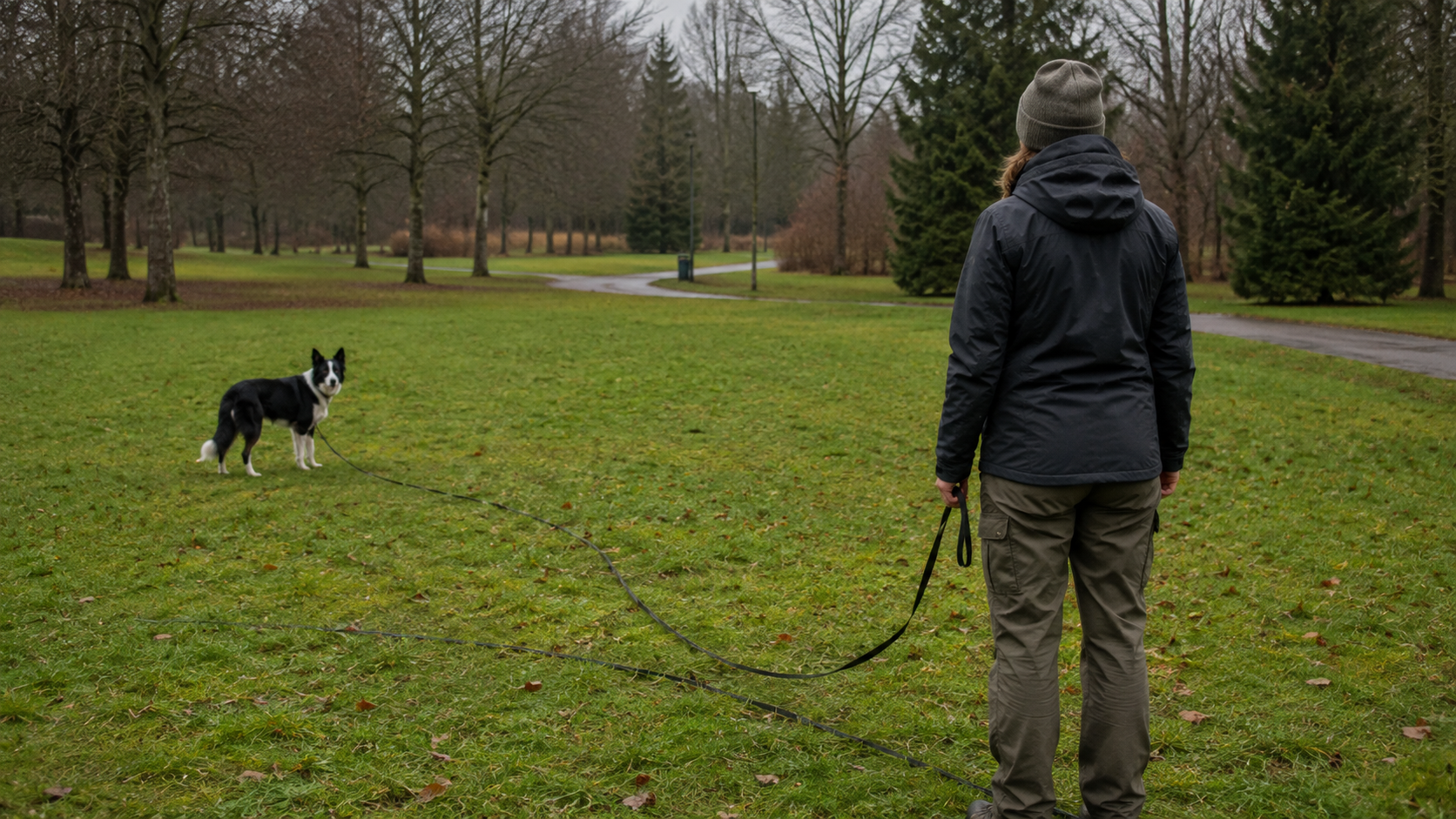
A long training line is useful here, even though it is not particularly elegant. It drags through wet grass, wraps itself around small bushes, and occasionally becomes more annoying than the dog. Still, it creates something valuable. It allows the dog to experience freedom without giving it complete freedom.
That difference matters.
With a long line, you can practise dog recall without gambling on the outcome. The dog can move away, explore, and make decisions, but cannot disappear into traffic or chase an animal across an open field.
The line should not be used to pull the dog back immediately after the cue. That may stop the dog, but it does not create a willing return. Instead, it acts as quiet insurance. You call, wait, encourage movement towards you, and only use the line to prevent the wrong choice from becoming a long adventure.
Dogs learn from what happens after a decision.
If ignoring you leads to twenty minutes of chasing, sniffing, and complete freedom, ignoring you has been rewarded. The fact that you were angry afterwards may matter far less than people assume. The best part already happened.
This is one reason recall problems can become stronger with time. Each failed call is not just an unsuccessful moment. It may be practice in not returning.
The cue itself also becomes worn out.
A dog hears its name, then the recall word, then the same word again. Soon there are several versions of it. A cheerful version, a frustrated version, a shouting version. Sometimes the word means come and get food. Sometimes it means the walk is over. Sometimes it means nothing happens because the owner gives up.
Words become reliable when consequences are reliable. Dogs are not careless about language. People are.
When a recall cue has been repeated hundreds of times without a clear result, it can be easier to choose a new one. Not because the original word is magically broken, but because both dog and owner need a cleaner beginning.
The new cue should be protected. Say it when there is a realistic chance of success. Reward the response properly. Avoid using it for unpleasant routines whenever possible.
That final part is often ignored. Imagine returning to someone and discovering that every return ends your freedom. The lead is attached, the game stops, and you go home. It would not take long to hesitate.
Sometimes call your dog, reward the return, and release the dog to explore again. That small habit changes the meaning of recall. Coming back no longer predicts the end of everything enjoyable.
What reliable dog recall actually looks like
Reliable dog recall does not always look dramatic.
There may be no instant turn, no full speed sprint, no perfect finish at your feet. Real recall can include a brief pause. The dog may look at the distraction, consider it, then choose to return.
That pause worries many owners. They want immediate obedience. I understand the feeling, especially near a road or around livestock, where a pause can be dangerous. Yet during training, the thinking moment is not necessarily failure. It may be the exact moment the dog is learning to make a better decision.
The aim is not merely to interrupt movement. It is to build a pattern strong enough to compete with instinct, excitement, uncertainty, and habit.
Rewards need to match that difficulty.
A dry piece of everyday food may work in the hallway. It may become completely irrelevant when another dog is running nearby. This does not mean your dog is stubborn or ungrateful. It means the payment does not fit the work.
Good rewards are personal. Some dogs care deeply about meat, cheese, or soft treats that can be eaten quickly. Others would rather chase a toy, play a short tug game, or be released back to sniffing.
Freedom itself can become a reward.
That is one of the most useful ideas in dog recall training. A dog comes back, receives praise or food, then hears a release word and returns to exploring. The dog learns that responding does not always remove access to the environment.
The return should feel safe too.
Owners sometimes punish a dog after it finally comes back because they are furious about the delay. The anger is understandable. You may have spent five minutes imagining accidents, arguments, and veterinary bills. Your hands are shaking, and the dog arrives looking pleased with itself.
Correcting the dog at that moment may feel justified, but it teaches a dangerous lesson. Returning to you leads to conflict.
The dog does not usually connect the punishment with the chase that happened several minutes earlier. It connects it with what is happening now. It came close. You became frightening.
Even when the delay has been ridiculous, the return should be received calmly. You can change the training plan later. You can use a longer line next time. You can reduce distractions and rebuild the response. What you cannot do is make coming back feel unsafe and still expect enthusiasm.
Body language plays a larger role than many people realise.
Standing still, facing a dog directly, and repeating a command can create pressure. Moving away, lowering your body, opening your posture, or running a few steps in the opposite direction can be more inviting.
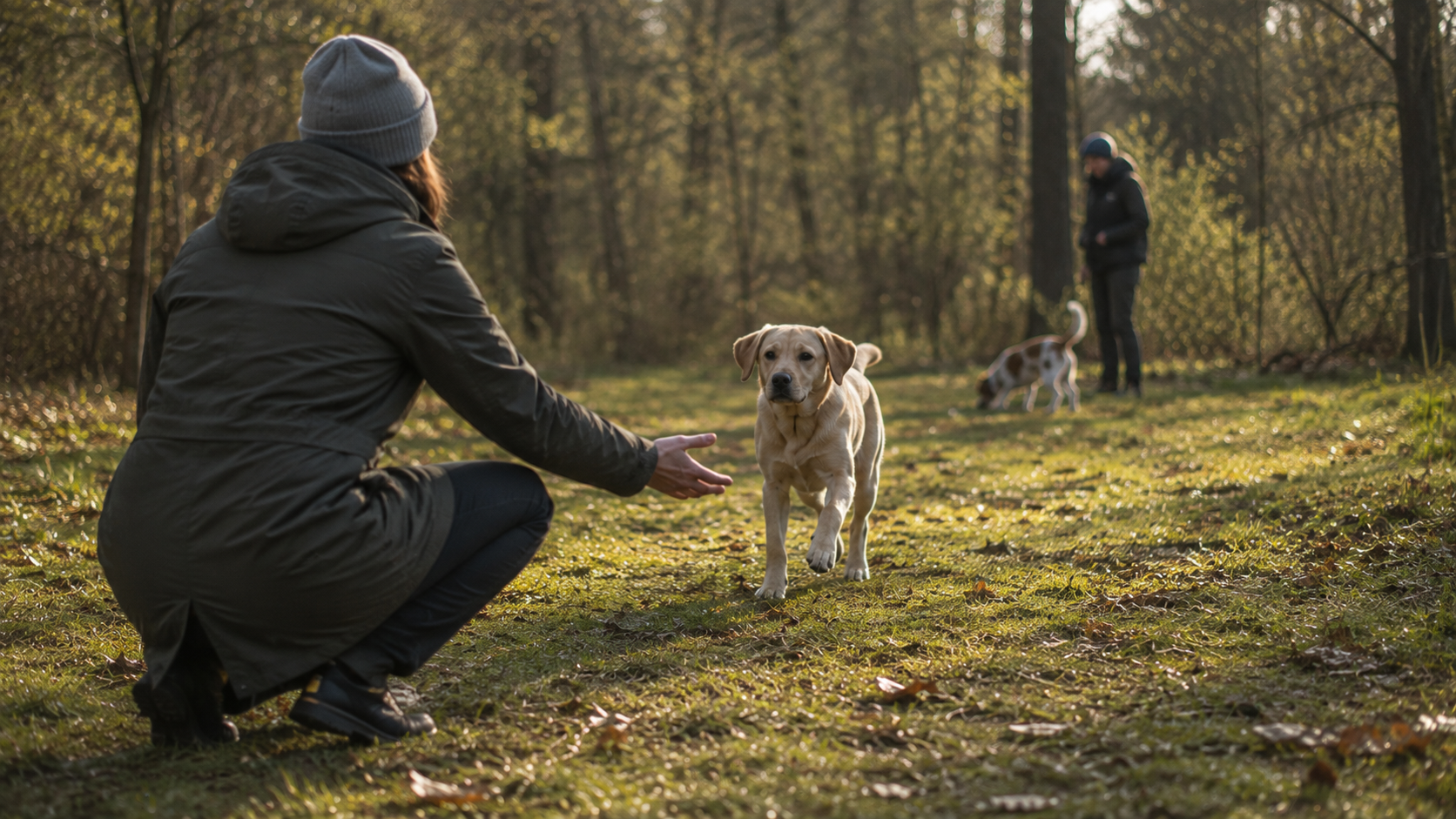
This can feel silly in public. Dog training often does.
There is a strange moment when an adult is crouching in wet grass, speaking in an overly cheerful voice while a young dog stares from a distance. Pride is not especially useful then. Movement and genuine excitement usually work better.
Still, recall should not become a permanent game of begging.
The dog needs to learn that the cue matters even when you are not waving food or running backwards. Lures can begin a behaviour, but rewards should follow the choice rather than advertise themselves before every response.
Hide the treat. Call once. Let the dog decide. Reward after the dog reaches you.
Over time, not every recall needs the same reward, but the dog should continue to believe that something worthwhile may happen. Predictability can weaken interest. A small reward sometimes and a remarkable reward occasionally can create more anticipation than the same piece of food after every return.
This does not mean becoming stingy too soon.
People often reduce rewards as soon as the dog shows basic understanding. They seem worried that food will become a permanent requirement. Yet a behaviour that is still fragile needs support. There is no prize for removing rewards quickly.
The outside world does not stop rewarding dogs. Smells remain interesting. Squirrels continue to run. Other dogs still invite interaction. Reducing your own rewards while environmental rewards remain powerful is not independence. It is poor competition.
There is also the question of breed and temperament.
Some dogs remain naturally close. They check where their owner is and rarely travel far. Others were shaped for movement, hunting, tracking, or independent work. Their attention travels outward.
It is unfair to expect identical progress from every dog.
A young retriever, a scent driven hound, and an older companion dog may all understand recall but experience the environment differently. Training should respect that difference rather than turn it into a moral judgement.
I am cautious when people describe a dog as disobedient after a few weeks of practice. Usually the situation is less dramatic. The dog has simply discovered that the world is interesting, and the training has not yet caught up.
Age matters as well.
Puppies often appear to have excellent recall because they are naturally dependent and reluctant to move far away. Owners become confident. Then adolescence arrives, and the same dog suddenly develops distance, curiosity, and selective hearing.
Nothing mysterious has happened. The dog has changed.
This is often the point when recall needs more structure, not more anger. Returning to a long line can feel like going backwards, but it is usually more sensible than repeatedly testing a behaviour that is no longer reliable.
Progress in dog training is rarely tidy. Some weeks feel easy. Then a new place, a hormonal change, or one exciting experience seems to undo everything.
It probably has not undone everything.
The useful question is not whether the dog knows the cue. The question is whether the dog can respond to it in this place, at this distance, with this distraction, on this particular day.
That is a less satisfying answer because it removes certainty. It also makes training more honest.
A reliable dog recall is built through hundreds of ordinary decisions. A turn of the head. One step towards you. A return from a smell. A choice to leave another dog. Small moments, often unnoticed by everyone except the person holding the line.
Eventually, the cue begins to carry its own emotional weight. The dog hears it and expects connection, movement, food, play, or another chance to run.
There may still be imperfect days. There may be places where the lead stays attached because the risk is not worth proving a point.
Perhaps that is part of good recall too. Not believing the dog has become a machine, but knowing when the training is strong, when it is uncertain, and when the world is simply asking too much.