
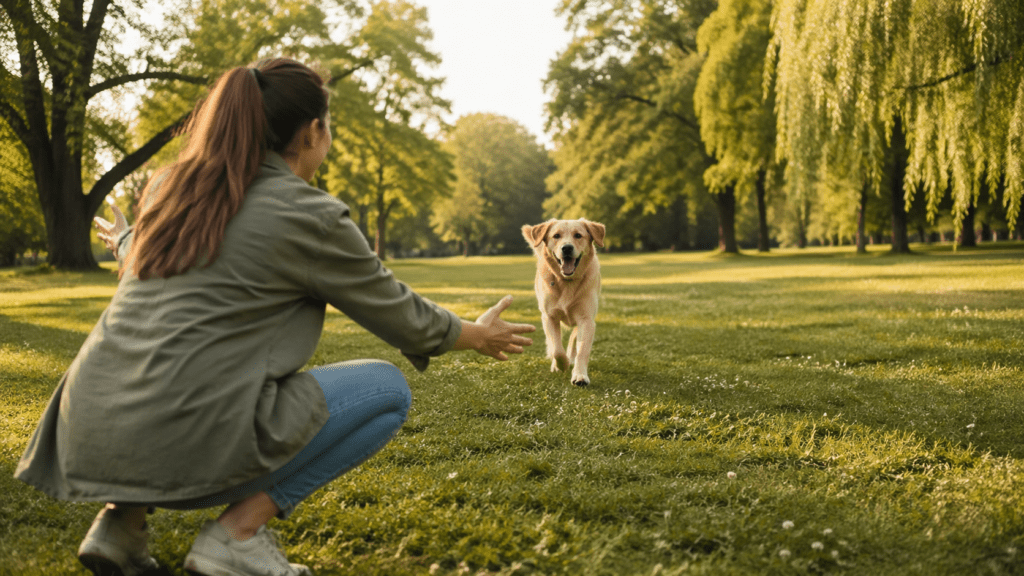
Dog recall is one of the most useful skills your dog can learn. It means your dog comes back to you when you call, even when there are other dogs, smells, people or open spaces around.
A good recall can make walks calmer and safer. It can also help in everyday moments, such as when a gate is left open, your dog drops the lead, or you need to move away from another dog.
Quick answer:
- Start dog recall training in a quiet place.
- Use one clear word, such as “come” or “here”.
- Reward your dog every time they come back.
- Practise with more distance and distractions slowly.
- Use a long line before letting your dog off lead.
What dog recall really means
Dog recall means teaching your dog to return to you when called. It sounds simple, but for many dogs it is not easy. Outside, there may be smells, birds, squirrels, other dogs, people, food, water or toys. These things can be much more exciting than coming back to their owner.
According to Dogs Trust, dogs need to learn that coming back is always a good thing and should lead to a reward they enjoy, such as food, praise or play.
Recall is not only for dogs that run off lead. The Blue Cross explains that recall is useful even if your dog is usually on a lead, because accidents can happen, such as a dropped lead or an open door.
A strong recall does not mean your dog will behave like a robot. It means you have built a habit through safe, repeated practice. Some dogs learn quickly. Others need more time, especially if they are young, nervous, independent, or very interested in the world around them.
How to start dog recall training at home
Start in a quiet place, such as your living room, hallway or garden. Your dog should not be too distracted. The Royal Kennel Club advises starting new behaviours in quiet places your dog knows well, because this gives them a better chance of success.
Choose one recall word. Simple words like “come” or “here” work well. Use the same word every time. Everyone in the home should use the same cue, so your dog does not get confused.
First, say your dog’s name in a happy voice. When they look at you, say your recall word and move a step away. When your dog comes to you, reward them straight away. Use a treat, praise, a toy, or anything your dog really likes.
Keep the sessions short. A few minutes of good practice is better than a long session where your dog gets tired or bored. Try to stop while your dog is still enjoying it.
Build recall slowly with distance and distractions
Once your dog comes back well at home, move to a garden or a safe enclosed space. Do not rush to busy parks too quickly. Your dog needs to learn in small steps.
The RSPCA advises gradually increasing the distance before practising in safe outside spaces. It also says long training leads can help because they give your dog freedom without giving complete free range too early.
A long line should be attached to a harness, not used to jerk or pull your dog. It is there for safety. Let your dog move a short distance away, call once, then reward warmly when they come back.
Add distractions slowly. For example:
- practise when there are no other dogs nearby,
- then practise when a dog is far away,
- then practise near mild distractions,
- later practise in more interesting places.
If your dog cannot come back in a new place, the training has probably moved too fast. Go back to an easier place and rebuild the habit.
Use rewards your dog actually cares about
Recall is hard because your dog often has to leave something interesting. A dry biscuit may not be enough if your dog is running, sniffing or watching another dog.
Dogs Trust recommends using exciting rewards, especially when your dog has come away from something interesting.
Good recall rewards may include:
- small soft treats,
- cooked chicken,
- cheese in tiny pieces,
- a favourite toy,
- a short game,
- happy praise,
- being allowed to go back and sniff again.
The last point matters. Do not only call your dog when the fun is over. If recall always means “lead on, walk finished”, your dog may start to avoid coming back. The RSPCA gives the same warning: do not only call your dog to put them back on the lead, because they may learn that coming back ends the fun.
A useful habit is to call your dog, reward them, touch their collar gently, then let them go back to sniff or play if it is safe. This teaches them that coming back does not always mean the end of freedom.
Common dog recall mistakes to avoid
One common mistake is calling again and again. If you say “come, come, come” while your dog ignores you, the word can lose meaning. The Blue Cross advises not calling continuously. If your dog does not come back, it may mean that more training is needed in that situation.
Another mistake is telling the dog off when they finally return. This can feel natural if you were worried or frustrated, but it can damage recall. Your dog may learn that coming back leads to anger. Blue Cross and Dogs Trust both advise staying calm and avoiding punishment after a poor recall.
Avoid these mistakes:
- calling your dog when you know they are unlikely to respond,
- chasing your dog as a game,
- grabbing the collar roughly,
- using recall only to end walks,
- shouting,
- punishing your dog when they return,
- letting your dog off lead too soon.
Recall should feel safe and rewarding for your dog. The RSPCA supports reward-based training, where dogs are set up to succeed and rewarded for the behaviour you want. It also states that reward-based training does not involve physical punishment or aversive methods.
Dog recall and safety in public places
Recall is not only a training issue. It is also a safety issue. In the UK, GOV.UK states that it is against the law to let a dog be dangerously out of control anywhere, including public places, private places and the owner’s home. A dog may be seen as dangerously out of control if it injures someone or makes someone worried that it might injure them.
In the countryside, recall is also linked to livestock and wildlife safety. The Countryside Code says dogs should be kept under control and in sight, and owners should be confident their dog will return on command. It also says dogs should be kept on a lead around livestock.
There are also stronger protections for farm animals in England and Wales. GOV.UK reported that from 18 March 2026, the maximum penalty for livestock worrying increased, and police gained powers to seize and detain a dog in certain cases where livestock has been attacked or worried.
This does not mean your dog can never enjoy freedom. It means off-lead time should be earned through training and used only where it is safe, legal and respectful to other people, dogs, wildlife and livestock.
When to get help with recall training
Ask for help if your dog keeps running away, ignores you in most places, chases livestock, chases cars, rushes at people or dogs, or becomes hard to control around distractions.
Dogs Trust advises using a long lead and secure areas if your dog keeps darting off, and suggests contacting a qualified trainer or behaviourist if training is not improving.
You should also speak to a vet if your dog’s behaviour changes suddenly. Pain, hearing problems, stress or illness can affect how a dog responds. Training is useful, but it should not replace medical advice when something seems unusual.
Choose a qualified dog trainer or behaviourist who uses kind, reward-based methods. Avoid anyone who recommends fear, force, shouting, shock collars, choke chains, prong collars or “dominance” methods.
A calm final note for better recall
Dog recall takes time, but it does not need to be complicated. Start small, reward well, practise often, and make coming back feel good for your dog.
The goal is not perfect control in every possible situation. The goal is a safer, happier dog who wants to return to you because they trust you and understand what to do.